
In our client work, the first real signs of SEO working usually show up within two to six months. The bigger gains build over the following year.
Technical fixes can show up within weeks. New pages, stronger content, and links take longer. That’s the honest range, and the rest of this post shows what it looked like on real sites.
When Buckshot General Contracting started with us in April 2026, their site earned 213 clicks from Google that month. By September it earned 394. Over the same stretch, the number of times their pages appeared in search went from 7,916 to 76,237.
Five months in, the clicks had grown, but the visibility had grown far faster. That gap is normal, and it tells you a lot about how SEO actually moves.
Why There’s No Single Answer
SEO isn’t one task with one finish line. It’s a set of fixes that Google notices at different speeds. A broken page that suddenly works again can be picked up the next time Google crawls it.

A new service page has to be found, indexed, and then trusted enough to compete. Links from other sites build slowly and keep paying off.
Your starting point matters too. A site that has been online for years with a few technical problems moves faster than a brand-new domain.
A plumber competing in a small town moves faster than a law firm competing across a metro area. Anyone who gives you one number without looking at your site is guessing.
A Realistic SEO Timeline, Month by Month
Weeks 1 to 4: Access, Audit, and the First Fixes
The first month is mostly finding out what’s wrong. We get access to Google Search Console and analytics and look at what the last 3, 6, and 12 months show.
Then we check whether important pages can be crawled and indexed. Quick fixes go in early: broken links, pages blocked by mistake, missing titles, tracking that doesn’t record calls.
Don’t expect a traffic jump yet. Google has to come back and see the changes first. Google’s own documentation says crawling “can take anywhere from a few days to a few weeks.”
Months 2 to 6: Visibility Before Clicks
This is where the early signal usually appears, and it shows up in impressions before clicks. Your pages start appearing for more searches, often in lower positions at first. Clicks follow as those pages climb.
Buckshot is a good example. In five months their impressions grew almost tenfold, while clicks grew 85%.
If you only watched clicks, you’d think the work was barely moving. If you watched impressions, you’d see Google testing the site for far more searches than before.
Months 6 to 12: The Climb Is Uneven
Progress in this stretch rarely runs in a straight line.
T&J All In Remodeling, a remodeler serving Waukesha County, started with no leads, no website traffic and no calls from search. Progress wasn’t a straight line, but today the website brings about 15 online leads a month and their Google Business Profile 13 to 15 calls a month.
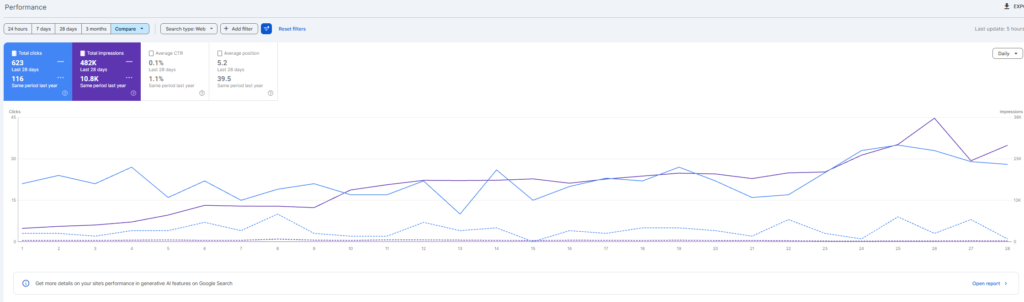
That November dip didn’t mean the work had failed. Rankings shift, seasons change demand, and Google updates its systems. What matters is the direction across several months, not any single one.
Year Two and Beyond: Compounding Gains
The largest gains we see usually come after the first year. By then a site has strong service pages, clean technical health, and links pointing at the right places.
Lehmann Electrical & Design is an electrical contractor we’ve worked with for about two years. Their monthly search clicks went from 215 in July 2025 to a peak of 1,716 in May 2026, and were at 1,167 in September 2026.
Gains like that come from layers of work stacking up over time. They’re one client’s results over a specific period, not a promise for your site.
What Speeds SEO Up and What Slows It Down
Things That Help
A site Google already trusts, problems that are mostly technical, a clear list of services and service areas, and someone available to make changes quickly. Accurate tracking also helps, because you can see what’s working and double down sooner.
Things That Slow It Down
A brand-new domain, a crowded market, thin pages that need rewriting from scratch, and changes that sit in a developer’s queue for months. So does a redesign that changes URLs without proper redirects, which can undo progress overnight.
How to Tell if SEO Is Working Before Rankings Move
Watch the leading signals in Search Console, not just your rank for one favorite keyword. Here’s what to look for in the first few months.
Impressions should trend up across the pages you’ve worked on. The number of search queries you appear for should grow.
Average position should improve on your service pages, even if they aren’t on page one yet. Then clicks, and finally calls and form submissions, should follow.
One more thing to watch: fewer impressions doesn’t always mean worse results. T&J’s impressions fell from 637,692 in May 2026 to 275,026 in June, yet clicks more than doubled, from 221 to 491.
Fewer people saw the site, but more of the right people clicked. That’s why we report on clicks and inquiries, not impressions alone.
Why Nobody Can Promise a Date
Be careful with anyone who promises page one by a certain month. Google is blunt about it in its own advice on hiring an SEO: “No one can guarantee a #1 ranking on Google.”
A good SEO partner can promise the order of the work and how quickly changes get made. They can also give you clear reporting on what was done and what changed. Our SEO services are built around exactly that.
How Long Does SEO Take? Common Questions
Can SEO work in 30 days?
Sometimes, for specific fixes. If a key page was blocked from Google or broken, fixing it can help within weeks of Google recrawling it. Lasting growth across a site usually takes several months.
Does local SEO take less time than regular SEO?
Often, yes, for the map results. Business Profile changes like categories, services, and hours can be picked up fairly quickly. Organic rankings for your website usually take longer to build.
Is it a bad sign if traffic drops in the first few months?
Not necessarily. Rankings move around while Google tests your pages, and seasonal demand changes too. Judge the trend over three to six months, not a single week or month.
Should I stop SEO once I rank?
Usually not. Competitors keep publishing, Google keeps updating, and pages slowly go out of date. You may need less work once you rank well, but stopping completely tends to let rankings slide.